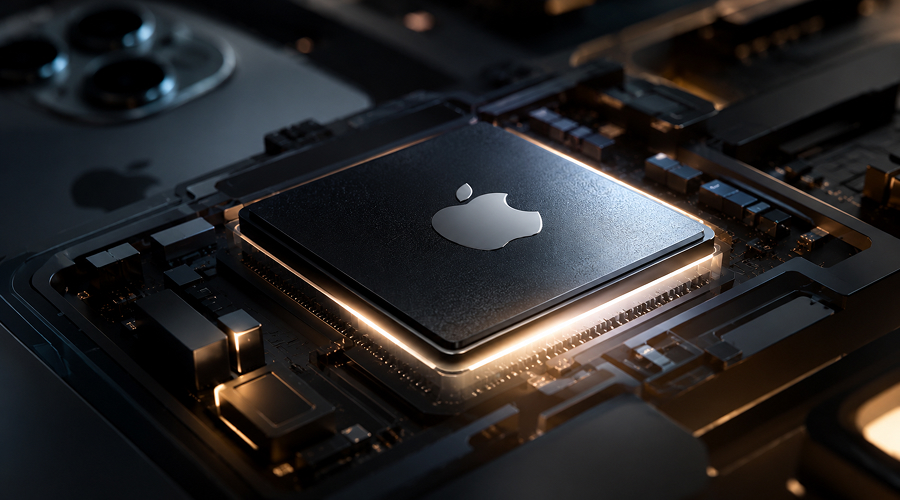
Apple’s A20 Pro is already making waves as it is expected to bring a major change to smartphone processors with its new 2nm technology. It is the first-ever 2nm chip in a smartphone, offering better speed, battery efficiency and AI performance. But what does 2nm mean, and how will it improve everyday iPhone use? Read on to find out. Here, we are discussing about the A20 Pro and how it could compare with other flagship smartphone chips. Let’s get started…
Apple A20 Pro – What Is It?
The Apple A20 Pro is Apple’s next-generation flagship processor that powers the iPhone 18 Pro models. It has replaced the A19 Pro and it offers better speed, graphics, battery life and AI performance. One of its biggest changes is the use of a new 2nm manufacturing process. Besides that, Apple has also changed the chip’s internal design to handle heavy tasks more easily and efficiently. This helps the processor handle demanding tasks such as gaming, video recording, photo editing and AI features more efficiently.
What Does 2nm Mean in Plain Language?
The term 2nm refers to the technology used to make a processor. It is known as a process node. It does not mean that the entire chip is 2 nanometres in size. Instead, it describes the technology used to build the tiny parts inside the processor.
A nanometre is one-billionth of a metre. Even a small improvement at this level can affect how a processor performs. The A20 Pro uses TSMC’s 2nm technology, also called N2. It uses a new transistor design that controls electricity more efficiently. This helps the processor deliver better performance while consuming less power.
Why Smaller = More Efficient
A processor has billions of tiny switches called transistors. These switches turn electricity on and off to perform different tasks. New manufacturing technology allows chipmakers to fit more transistors into the same space and make them work better.
This offers two most important benefits:
- Better Performance: The processor can complete tasks faster and more smoothly.
- Lesser Power Use: The processor uses less electricity, which can help save battery life.
This becomes more important for smartphones because they have small batteries and limited space for cooling. A more efficient processor ensures better performance while using less battery power.
3nm vs 2nm Real-World Difference
The A19 Pro uses 3nm technology, while the A20 Pro uses a more advanced 2nm process. This upgrade is expected to improve speed, power efficiency and heat management. Definitely, it does not guarantee a fixed performance or battery improvement but users may notice better performance in everyday use, especially when they will indulge in online gaming, perform demanding AI tasks and so on. The real improvement will be noticed in power management and longer battery life.
A20 Pro vs A19 Pro — What Actually Improved

The A20 Pro is said to bring improvements across the CPU, GPU and Neural Engine. Apple has also improved memory bandwidth, allowing the processor to access data faster.
Here are the main changes:
| Features | A19 Pro | A20 Pro |
| CPU | 6-core | 6-core |
| GPU | 6-core | 7-core |
| Neural Engine | 16-core | Dual 16-core |
| Memory Bandwidth | Previous generation | 50% higher |
| Manufacturing Process | 3nm | 2nm |
Besides these, Apple has also improved the chip’s internal design to handle heavy tasks more easily and efficiently.
CPU Speed
The A20 Pro has a 6-core CPU with two performance cores and four efficiency cores. The performance cores handle heavy tasks. Efficiency cores, on the other hand, manage everyday activities while using less power. Apple’s new performance cores are said to be up to 20% faster than the previous generation. This can make tasks such as opening apps, editing videos, handling large files and running demanding apps faster. People who multitask or work with large files may notice a significant difference.
GPU Performance
The GPU handles graphics-related tasks, such as gaming, animations, video effects and image processing. The A20 Pro comes with a redesigned 7-core GPU. Apple claims that the new GPU delivers up to 40% faster graphics performance.
Also, it supports hardware-accelerated ray tracing, which helps create more realistic lighting, reflections and shadows in supported games. These improvements could deliver smoother gaming, better graphics and faster video editing.
Neural Engine and On-Device AI
The A20 Pro is designed to handle AI tasks faster with its 32-core Neural Engine, which is expected to offer twice the AI processing power of the A19 Pro. This could improve photo editing, voice features, image recognition and other AI tools. Also, it can process supported tasks directly on the phone, improving speed and privacy.
Apple C2 Modem — Bundled with A20 Pro

The iPhone 18 Pro models also feature Apple’s new C2 modem for mobile network connections, in addition to the new A 20 Pro chip. It works separately from the A20 Pro chip but helps improve overall performance. The C2 modem offers faster upload speeds than the previous C1X modem while using 15% less power.
Also, it supports mmWave 5G in the US. These improvements ensure better network connections, faster uploads and improved battery efficiency. However, actual speeds will depend on network coverage and the mobile carrier.
How A20 Pro Compares to Snapdragon 8 Elite Gen 5 and Tensor G6
Apple is not the only company developing faster and more power-efficient smartphone processors. Qualcomm and Google also offer powerful chips for their flagship phones.
Here’s a comparison of the three processors:
| Features | Apple A20 Pro | Snapdragon 8 Elite Gen 5 | Google Tensor G6 |
| Manufacturing Process | 2nm | 3nm | 3nm |
| CPU | 6-core | 8-core | 7-core |
| GPU | 7-core | Adreno 840 | PowerVR |
| Modem | Apple C2 | Snapdragon X85 | MediaTek M90 |
| Focus On | Performance and AI | Gaming and performance | AI and photography |
The Snapdragon 8 Elite Gen 5 is Qualcomm’s top processor designed for premium Android phones. Built with a 3nm process, this Qualcomm’s processor uses new Oryon CPU cores and an Adreno GPU. It delivers faster performance, better gaming and improved power efficiency.
The Google Tensor G6, on the other hand, powers the Pixel 11 series. It includes an upgraded AI processor to run Google’s AI features directly on the phone. It mainly focuses more on AI features, photography and everyday use.
The A20 Pro uses newer 2nm technology; however, it does not automatically make it faster than the other chips. Actual performance, gaming tests and battery life will help determine which processor performs better.
Does Chip Generation Matter for Everyday Users?

Different people have different needs when they use a smartphone. Not every person needs the fastest smartphone processor. Some people use their phones only for browsing, messaging, watching videos, taking pictures and social media. If so, older flagship chips can handle these tasks easily.
However, users who regularly work across apple devices may benefit from improved performance, efficiency and seamless handling of demanding tasks.
However, the A20 Pro could be more useful for people who play heavy games, edit videos, use AI features or run multiple apps simultaneously. Its improved power efficiency is yet another benefit as it helps the battery last longer. Better chip design and cooling may help the phone maintain its performance without overheating.
Moreover, a phone with powerful processor can handle new apps and features for several years. However, overall performance also depends on battery life, software, cooling, display and memory.
The Bottom Line
So, this is all about the Apple A20 Pro chip. The new chip brings major improvements over the previous generation A19 Pro. It offers 2nm technology, better graphics, faster AI processing and improved power efficiency. It is expected to make the iPhone 18 Pro models faster and more capable. However, its real benefits will depend on battery life, everyday performance and how well it handles demanding tasks.