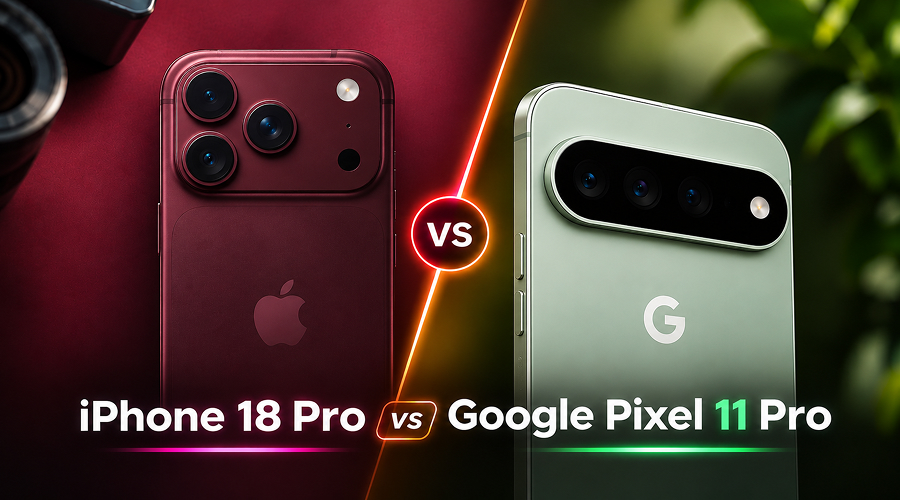
2026 is the year of flagship devices, with the iPhone 18 Pro and Google Pixel 11 Pro competing to offer the best smartphone experience. Both phones offer premium designs, powerful processors, OLED displays and advanced cameras. iPhone 18 Pro stands out for its variable aperture feature.
Google Pixel 11 Pro, on the other hand, focuses on AI and software to improve photos. With both phones competing in the premium segment, making the best camera phone choice may be challenging. But worry not! In this post, we are discussing how these two devices differ on camera setups, and which one offers the best performance. So, without any further, let’s get started…
Quick Verdict
The iPhone 18 Pro is ideal for users who want more camera control, quality videos and a smooth iOS experience. The Pixel 11 Pro, on the other hand, makes a better choice for point-and-shoot photography, zoom and AI camera features. Both offer a premium experience but cater to different photography needs.
iPhone 18 Pro vs Google Pixel 11 Pro: Key Specs
Here is a difference between the two flagship devices based on key specs. Take a look…
1. Design and Build
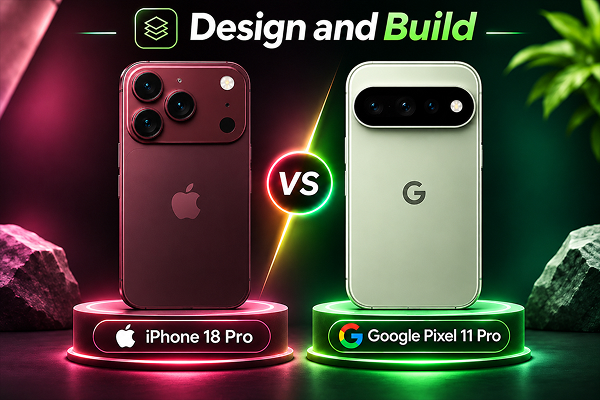
Apple and Google retain their signature designs in their latest Pro phones. The iPhone 18 Pro has flat edges, a metal frame and a glass back, while the Pixel 11 Pro features rounded edges and Google’s distinctive rear camera bar. Both offer a premium finish and water and dust resistance. Google’s phones are also known for their clean Android experience, distinctive designs and advanced camera capabilities.
The iPhone has a more traditional look, while the Pixel stands out with its simple design and camera bar.
2. Display — 6.3-inch, Both OLED, Key Differences
Both the devices (iPhone 18 Pro and Pixel 11 Pro) include a 6.3-inch OLED display with a 120Hz refresh rate. The iPhone 18 Pro includes a Super Retina XDR display with a resolution of 2622 x 1206 pixels and it reaches up to 3,000 nits of brightness outdoors. It offers sharp details, rich colours and deep blacks.
Also, it includes ProMotion technology that adjusts the refresh rate for smooth scrolling and better battery efficiency.
The Pixel 11 Pro come with Google’s Super Actua LTPO OLED display. It offers a resolution of 1280 x 2856 pixels and a peak brightness of up to 3,600 nits, making it easier for users to see the screen in bright sunlight. Both screens support HDR content and adaptive refresh rates of up to 120Hz.
The Pixel is slightly brighter; however, the iPhone offers Apple’s familiar colours and display quality. Both offer great everyday performance whether you are watching videos, playing games, web browsing and scrolling through social media.
3. Performance — A20 Pro vs Tensor G6
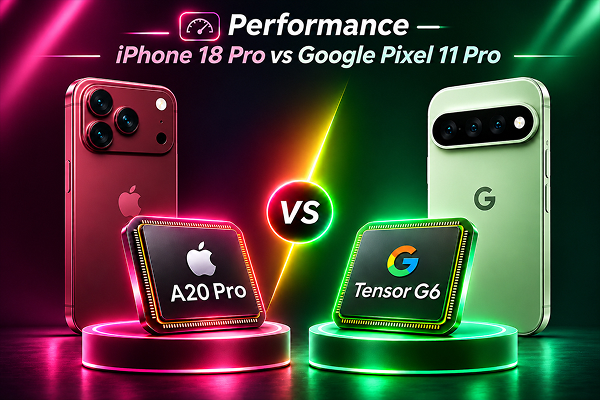
Both the brands use their own processors in their latest flagship phones. The iPhone 18 Pro runs on the A20 Pro, whereas the Pixel 11 Pro uses Google’s Tensor G6.
The A20 Pro uses TSMC’s 2nm technology and features a six-core CPU, a seven-core GPU and an improved Neural Engine for better gaming, editing and AI performance. Google’s Tensor G6, on the other hand, focuses more on AI, photography and smart features. While Apple prioritises processing and graphics power, Google focuses on AI-based tasks and everyday use.
Both are capable of handling everyday tasks well. The A20 Pro is a great choice for people who play demanding games and edit videos on their phones. The Tensor G6, on the other hand, is ideal for users who rely on Google’s AI tools.
4. Camera — The Core Difference
Both the devices include three rear cameras. However, they have a different approach to photography altogether. Apple offers excellent camera hardware and manual control, whereas, Google relies on AI and image processing to improve photos with minimal effort. Here is how these two devices differ on camera features:
4.1. Main Sensor: Variable Aperture iPhone vs Computational Pixel
The latest iPhone 18 Pro includes a 48MP main camera with variable aperture, one of Apple’s biggest camera upgrades in 2026. The new phone offers four aperture settings: f/1.48, f/1.8, f/2.8 and f/4.0. Variable aperture controls how much light enters the lens, helping with low-light shots, focus and background blur. It also gives users more control through camera hardware rather than software alone.
The Pixel 11 Pro, on the other hand, comes with a 50MP main camera and relies more on computational photography. Google’s image processing improves colours, brightness and details. While, Night Sight and HDR also help capture clear, balanced photos in low light and challenging conditions.
The iPhone is ideal for users who like to control camera settings, while the Pixel makes it easier to take great photos automatically.
4.2. Zoom: 5x Optical iPhone vs Pixel 120x Pro Zoom
Zoom photography is another important difference between these two flagship devices. However, the advertised zoom numbers need a closer look.
The iPhone 18 Pro offers a 48MP telephoto camera with 4x optical and 8x optical-quality zoom. The Pixel 11 Pro has a 48MP telephoto camera with 5x optical zoom and up to 120x AI-assisted zoom. While the Pixel offers greater zoom range, image quality may drop at higher levels due to digital processing.
The iPhone offers enough zoom for everyday photos, while the Pixel is better for capturing distant subjects.
Ultra-Wide
Both smartphones feature 48MP ultra-wide cameras for capturing landscapes, buildings and group photos. The iPhone has a 120-degree field of view and macro support, while the Pixel offers a wider 123-degree view with autofocus and Macro Focus.
Both phones offer flexible photography options, but the Pixel captures a slightly wider view. Photo quality also depends on lighting, software and the subject.
4.3. Video and Stabilization
Apple has always focused on video recording, and the iPhone 18 Pro continues this approach. It supports 4K Dolby Vision recording at up to 120fps with its main camera. Also, it offers ProRes recording, improved low-light video and advanced stabilisation. These features make it an ideal choice for vloggers, content creators and people who want more control over their recordings.
The Pixel 11 Pro also includes some of the most advanced video features, such as 4K recording, optical and electronic image stabilisation and AI-assisted processing. It can handle everyday video recording and social media content comfortably.
All in all, the iPhone is better for users who need advanced video features, whereas, the Pixel is excellent for easy recording with good stabilisation.
4.4. Selfie: 18MP iPhone vs 42MP Pixel
The iPhone 18 Pro includes an 18MP Center Stage camera. It keeps users in the frame during calls and recordings. Also, it supports autofocus and 4K video. The Google Pixel, on the other hand, includes a 42MP selfie camera with a wider view. Pixel’s higher-resolution front camera makes it a great choice for group photos. However, one should consider lighting, colours and software, as higher resolution does not alone do the magic.
The iPhone is better for video calls and recording, whereas, the Pixel is ideal for group selfies with its wider front camera.
5. Battery — 4,288mAh vs 4,840mAh
Battery capacity is another area where Google has upper hand (at least on paper). The Pixel 11 Pro comes with a larger 4,840mAh battery, whereas, the iPhone 18 Pro includes a 4,288mAh battery.
However, it’s worth noting that the battery life also depends on software and power efficiency. Apple’s strength lies in its A20 Pro and iOS 27, while Google uses Tensor G6 and Android 17 to manage battery use. According to Google, the Pixel can to provide more than 30 hours of battery life under Google’s stated usage conditions.
Daily tasks like browsing, messaging, taking photos and watching videos are breeze in both the devices. Gaming and frequent camera use may drain the battery faster. The Pixel has a larger battery, but real-world tests are still required to know its actual battery capacity.
6. Charging — 45W iPhone vs 30W Pixel
The iPhone 18 Pro supports fast USB-C charging. It reaches around 50% in 15 minutes with a compatible 60W adapter. The Pixel 11 Pro, on the other hand, reaches about 55% in 30 minutes with its 30W charger. Both support wireless charging up to 25W. None of these devices include a charging adapter in the box.
7. Software — iOS 27 vs Android 17
The iPhone 18 Pro runs on iOS 27 and the Pixel 11 Pro come with Android 17. iOS 27 ensures a smooth experience, strong privacy and easy connection with Apple devices. Also, it includes Apple Intelligence and an improved Siri. The Pixel 11 Pro, on the other hand, runs Android 17 with Gemini AI and it offers features like, smart photo editing along with more customisation options. iPhone 18 Pro is an excellent choice for people who are fond of Apple iOS ecosystem. Pixel, on the other hand, is excellent choice for those who want greater flexibility and Google integration.
8. Update Policy
Google Pixel 11 Pro comes with seven years of software and security updates, along with regular Pixel Drops. Apple does not promise a fixed update period, but it is known for supporting iPhones with software updates for several years.
9. Price
The iPhone 18 Pro starts at ₹1,64,900 for the 256GB model, with storage options up to 2TB. The Google Pixel 11 Pro starts at around ₹1,19,999, with options up to 1TB.
Quick phone comparison on prices:
| Features | iPhone 18 Pro | Pixel 11 Pro |
| Starting Price (India) | ₹1,64,900 | ₹1,19,999 |
| Display | 6.3-inch OLED | 6.3-inch OLED |
| Processor | A20 Pro | Tensor G6 |
| Main Camera | 48MP | 50MP |
| Ultra-wide | 48MP | 48MP |
| Telephoto | 48MP, 4x optical | 48MP, 5x optical |
| Selfie Camera | 18MP | 42MP |
| Battery | 4,288mAh (select markets) | 4,840mAh |
| Operating system | iOS 27 | Android 17 |
The Pixel 11 Pro is undoubtedly, more affordable than iPhone 18 Pro. The Pixel 11 Pro offers premium features at a lower price, making it a good value choice.
Which One Should You Buy?
Well, the choice between the iPhone 18 Pro and Google Pixel 11 Pro depends on your budget, photography needs and software preferences. If you want greater camera control, advanced video features, powerful performance, gaming capabilities and Apple’s ecosystem, then choose the iPhone 18 Pro.
However, if you prefer easy photography, better zoom options, a higher-resolution selfie camera, Google’s AI features, a larger battery and a lower price, then the Google Pixel 11 Pro is your best bet.
The Bottom Line
So, there you have it: the differences between iPhone 18 Pro and Google Pixel 11 Pro. Both devices offer different approaches to flagship smartphone photography. Apple focuses on camera hardware, manual controls and professional video recording, while Google uses AI and computational photography to make taking good pictures easier.
Both smartphones are capable of handling everyday photography, gaming, video recording and other demanding tasks. The choice of course depends on your personal needs and budget. The iPhone 18 Pro is ideal for users who want more camera control, advanced video features and Apple’s ecosystem. The Pixel 11 Pro, on the other hand, makes a great choice for those who prefer easy photography, longer zoom, a larger battery and a lower price. Choose the one that best fits your needs and budget!