Modern smartphones come with several different features, such as phone displays often described as FHD+, QHD+, 4K and PPI. These terms tell you how sharp and clear the display looks but not everybody knows that. And people often end up spending on such features. But the question is – do you really need to invest on a higher resolution phone for a better viewing experience? Not exactly. A higher resolution can make text, photos and videos look sharper. But this difference is almost impossible to notice on a small screen during everyday use.
Moreover, higher resolution often uses more battery. So, what do screen resolution and PPI mean? And do you really need to pay more for a QHD+ or 4K display? Read this post to understand them in detail. Let’s dive in…
What Is Screen Resolution on a Phone?
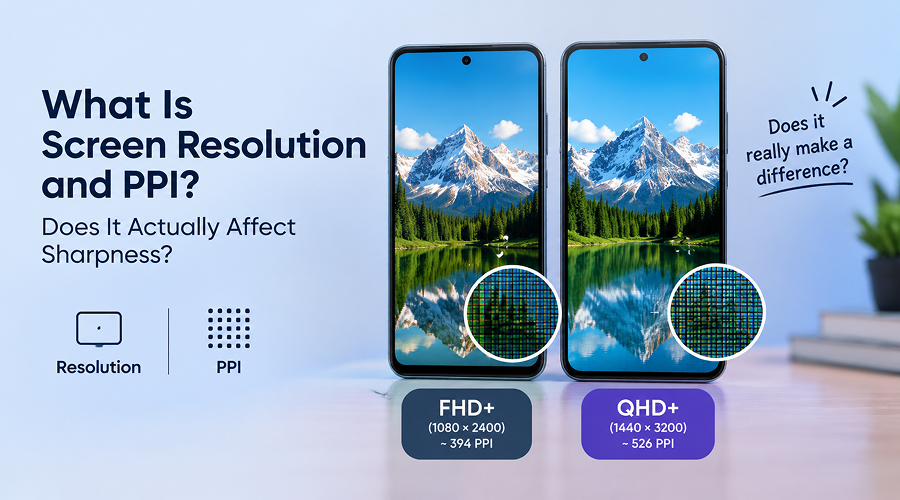
Screen resolution refers to the number of pixels used to create the image on a phone’s display. It is often mentioned as two numbers showing the number of pixels across and down the screen. For example, you must have seen a display with a resolution of 2400 × 1080 pixels. This means that it has 2,400 pixels horizontally and 1,080 pixels vertically. More pixels can make a screen look sharper, with clearer text and more detailed images. Besides these, you may also see terms like HD+, FHD+ and QHD+ in phone specifications.
- HD+ usually has a lower resolution and is found on affordable phones.
- FHD+ offers a good balance between sharpness, performance and battery life.
- QHD+ has more pixels than FHD+ and is generally found on premium smartphones.
- 4K has an even higher resolution, but it is uncommon on smartphones.
The “+” in FHD+ and QHD+ means the display has a slightly different resolution or aspect ratio than the standard version. For example, FHD+ can be 2400 × 1080 pixels instead of standard Full HD’s 1920 × 1080. However, resolution alone does not determine display quality. Screen size, PPI, brightness, colours, contrast and panel quality also matter.
What Is PPI (Pixels Per Inch)?
PPI stands for Pixels Per Inch. It shows how densely the pixels are packed on a screen. Pixels are tiny dots that make up the display. The more pixels packed into each inch, the higher the PPI and the sharper the screen looks. That’s the reason most users care about screen size when comparing display resolution. Know that a smaller phone with the same resolution can look sharper than a larger one.
Higher PPI generally help with sharper text, cleaner edges, more detailed images, less visible individual pixels and smoother-looking graphics. Higher PPI can make small text and fine details look clearer, but beyond a certain point, the difference is hard to notice in everyday use.
At What PPI Does the Human Eye Stop Noticing Difference?
There is no single PPI number as such at which the human eyes suddenly stop noticing improvements. Moreover, viewing distance equally matters.
For instance, if you hold your phone very close, you may notice small differences between displays. But seeing these differences at a normal viewing distance is often hard. Most modern phones already have high pixel density. Many FHD+ phones offer around 400 PPI or more, while QHD+ phones can go above 500 PPI. At these levels, seeing individual pixels is very difficult during normal use.
A higher PPI can make text and fine details look clearer, especially when viewed up close. But the difference is often small compared with moving from a low-resolution screen to a good FHD+ display. So, PPI should not be the only thing to consider. A good FHD+ OLED screen can look great, while a higher-resolution screen may not look better if its brightness or colours are poor.
FHD+ vs QHD+ vs 4K on a Phone — Is the Upgrade Worth It?
FHD+ is already sharp enough for everyday use. It provides enough detail for browsing websites, reading messages, watching videos, using social media and playing games. Here is how FHD+, QHD+ and 4K differ:
1. FHD+
FHD+ is often found in budget, mid-range and premium phones. It offers a perfect balance of display quality, battery life and price. You get a sharp display without using as much battery as a higher-resolution screen. For most people, a good FHD+ display is more than enough.
2. QHD+
QHD+ has more pixels and can make the screen look sharper. It is often found on larger premium phones. You may notice the difference in small text and detailed photos. However, the difference from a good FHD+ display may be hard to notice in everyday use.
3. 4K
4K smartphone displays are not very common. They offer more detail than QHD+, but the difference is hard to notice on a small phone screen. For most people, FHD+ or QHD+ is enough for everyday use. A 4K display may be useful if you often watch high-resolution videos.
Is Upgrading From FHD+ to QHD+ Worth It?
Well, the decision to upgrade from FHD+ to QHD+ depends mainly on what you value and how much you are ready to spend. If you want maximum sharpness and are already buying a premium phone, QHD+ can be an excellent choice. However, if you are looking for a good balance of display quality, battery life and price, FHD+ is often considered best.
How Resolution Affects Battery Life
A higher-resolution display has more pixels to light up and power. So, for example, a QHD+ screen has more pixels than an FHD+ screen. The more pixels make the phone work harder, especially while gaming or running heavy apps, due to which it uses more battery. However, screen resolution is not the only factor that affects battery life. Screen brightness, refresh rate, processor efficiency, screen technology and the apps also affect the battery life.
It’s simple – a 120Hz display often uses more power than a 60Hz display. Brightness also affects battery life, with brighter screens using more power. Some phones; however, let you change the screen resolution. You can use a higher resolution for more detail or a lower one to save battery. For everyday use, an efficient FHD+ display can offer good sharpness while using less power.
The Bottom Line
So, this is all about screen resolution and PPI. Screen resolution and PPI affect display sharpness, but more pixels do not always mean a better screen. Resolution shows the number of pixels, while PPI shows how closely they are packed. A higher PPI can make text and images sharper, but the difference is hard to notice on high-density screens. For most people, FHD+ is enough, while QHD+ offers more detail and 4K has limited benefits on a small screen.
Hence, when choosing a phone, look beyond resolution. Brightness, colour quality, refresh rate, screen size, panel technology and battery life all matter. So, if you are buying a phone look for a well-balanced display, instead of just focusing on the highest resolution. A well-balanced display can offer a great viewing experience without extra pixels.