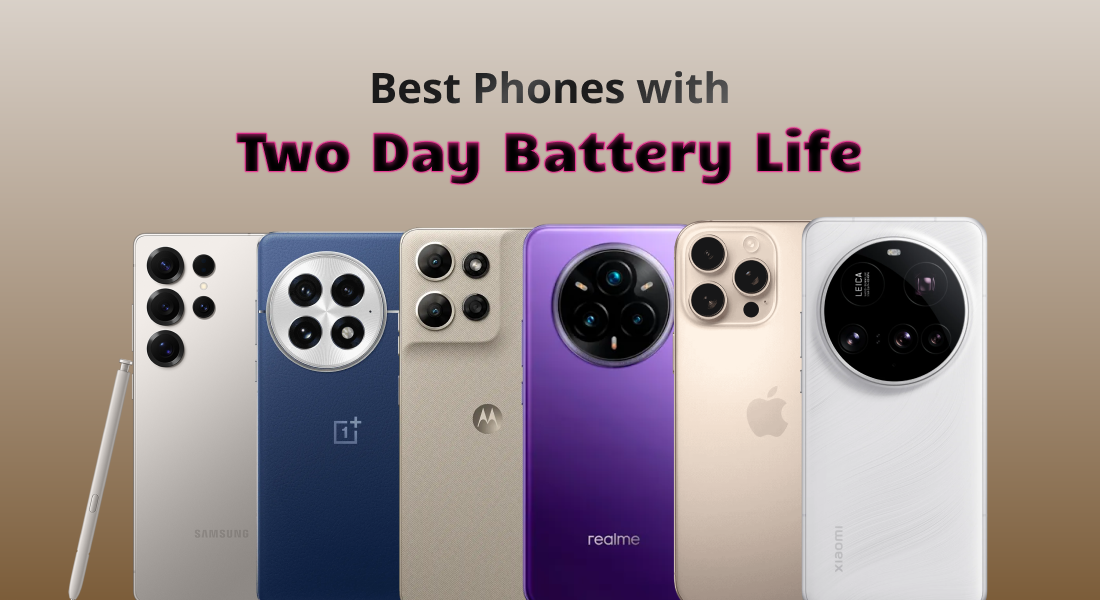
Buying a phone in 2026 means balancing speed, cameras, and battery life all at once. But what if you didn’t have to look for a charger all the time? These are the best multi day battery phones you can buy right now, so you can quit fretting over a low battery forever.
What Battery Capacity Actually Gets You Two Days
A 5,000mAh battery isn’t necessarily a two day battery. One phone will drain in under eighteen hours if you’re a heavy gamer, whereas another with the same cell can last fifty hours, thanks to efficient chip architecture and a better screen.
When shopping for a two day battery phone, look for 5,000mAh or more, ten to fourteen hours of screen on time, a chipset built on a four nanometer process or smaller, an adaptable refresh rate that can dip down to 1Hz, and an OS with aggressive app control.
Your highest priority is to screen on time. A model that scores twelve or more hours of screen on time will generally last two days for most people with normal mixed use. Efficiency matters too. Phones paired with the Snapdragon 8 Elite, MediaTek Dimensity 9400, or Apple A18 Bionic all use a process smaller than four nanometers, which executes tasks more quickly with less battery drain than older processors. A phone with 4,800mAh and a newer processor will almost always finish last than one with a 5,500mAh cell and an older processor.
Top Picks for Multi Day Battery Life
Nine phones, split into three categories: best overall, best budget pick, and best flagship pick!
Best Overall
- Samsung Galaxy S25 Ultra. Powered by the Snapdragon 8 Elite on a three nanometer process, and handles battery to a stupendous degree of precision. The 5,000mAh and a 6.9 inch Dynamic LTPO AMOLED, 1Hz to 120Hz, and 45W wired or 15W wireless charge give over thirteen to fifteen hours of screen on time, which is enough for almost any professional to not have to charge at night.
- Google Pixel 9 Pro XL. The Tensor G4 relies primarily on device AI processing, and keeps background data usage low and radio activity down – the subtle sooner or later overnight battery drain that kills most phones over a long term. The 5,060mAh and 6.8 inch LTPO OLED offer well over two days with this Extreme Battery Saver mode and have eleven to thirteen hours of regular screen on time, and 37W wired or 23W wireless charging.
- OnePlus 13. A giant 6,000mAh battery with some of the fastest charging available, and a 6.82 inch LTPO AMOLED. Screen on time closely sits around fourteen to sixteen hours, with 100W wired can get from zero to full under forty minutes.
Best Budget Pick
- Motorola Moto G Power, 2026 model. Its 6000mAh battery is just cells and wires, built purely for endurance. It may not compete with flagship speeds, but it will likely outlast them, reaching sixteen to eighteen hours of screen on time from a near stock Android experience with minimal additional software. Powered by MediaTek’s Helio G99 Ultra chip it offers 30W charging.
- Samsung Galaxy A56. It brings flagship level display quality to the mid-range market. Its 5000mAh cell and 6.7 inch Super AMOLED display reach eleven to twelve hours of screen on time thanks to One UI’s power management, and it charges at 45W.
- Realme 14 Pro Plus. A budget phone that knows its worth, with a 6000mAh battery, a 6.77 inch AMOLED display reaching thirteen to fifteen hours of screen on time. The 80W charging takes the phone from empty to full in roughly forty-five minutes.
Best Flagship Pick
- Apple iPhone 16 Pro Max. Holds a smaller 4,685mAh battery than most Android competitors, but still routinely beats them in real life endurance. The A18 Pro chip is the most efficientOn the market today, and with Apple’s tight hardware and software integration, every mAh is used at max efficiency. The average user gets across a second day with plenty remaining, charging to 100V in 27W via USB-C or 25W via MagSafe.
- Xiaomi 15 Ultra. Combines a 5,500mAh battery with Snapdragon hardware and efficiency for thirteen to sixteen hours of real world screen on time, on a 6.73 inch LTPO AMOLED panel. HyperOS actively monitors usage and changes background activity, and 90W wired chargers return the phone to 100V in roughly thirty-five minutes.
- Samsung Galaxy S25 Edge. Demonstrates that being thin does not mean having a weak battery. Its 3,900mAh battery is small for a flagship phone, but the Snapdragon 8 Elite chip and adaptive display technology help make up the difference. Real world screen on time comes in at ten to eleven hours, and the available 25W wired and 15W wireless chargers return the handset to full in about fifteen minutes.
Battery Capacity Vs Software, Which Matters More
Does a bigger battery always win, or does smarter software take over eventually? Software matters more than most buyers realize. The iPhone 16 Pro Max runs on 4,685mAh against the OnePlus 13’s 6,000mAh cell, yet in real testing the gap in actual endurance is far smaller than the capacity numbers suggest, because Apple controls every layer of power delivery with a finesse that Android makers are still working to match.
Good battery software lowers the screen refresh rate based on what’s on screen, limits waking up apps that you rarely use, cuts back on unnecessary 5G signal searching where coverage is weaker, cools the chip so performance is consistent, and can even charge to eighty percent overnight before topping it off before you get up. However, software can’t do everything. Anyone who plays heavy games or shoots long-form 4K video will see that a bigger cell indeed makes a difference. The two work best together, not as a replacement for each other.
How Charging Speed Changes Battery Habits
Fast charging has shifted word-of-mouth opinions about phones. When a device can recover half its charge in less than twenty minutes, battery life becomes less important, as you can top up at lunch or before leaving the office. Budget phones run between 18W and 30W, and hit fifty percent in forty to sixty minutes. Mid-range phones run between 33W and 67W, and hit fifty percent in twenty-five to thirty-five minutes. Flagship Android phones, at 80W to 120W, hit fifty percent in twelve to twenty minutes, and iPhones on MagSafe, at 25W, hit fifty percent in thirty to forty minutes.
People who have a charging speed above 100W tend to charge their phones in short spurts throughout the day, rather than charging overnight. That said, you can damage a battery if you fast charge a battery repeatedly and intentionally, so check for smart charging protection that limits the peak voltage of battery charging so that you prevent battery damage in the long term.
A Few Ways to Stretch Battery Life Further
Smart habits can give your good phone a few extra hours a day, free of charge. Keep the screen brightness at 50 to 60 percent when indoors, and select adaptive brightness over this custom setting. Set your phone to 4G in weak signal areas (instead of 5G) and ensure that Bluetooth and Wi Fi are off when you’re not using them. Take a monthly look at what apps can refresh in the background, and delete the ones you don’t use. Enable dark mode on OLED screens to reduce pixel power draw. Keep the battery in the range of 20 to 80 percent for daily use and use a charger that is certified by the phone manufacturer.
The Bottom Line
Two-day battery life is not a feature reserved for rugged niche phones; in 2026, the mainstream flagship and mid-range phones routinely beat this mark. That said, you don’t want to buy an ordinary phone; the most balanced overall choice is the Samsung Galaxy S25 Ultra, the Moto G Power dominates the budget segment while the iPhone 16 Pro Max proves that smart software can add more battery life to a modest-sized battery.
When choosing your next phone, look beyond the mAh number on the spec sheet. Chip efficiency, display technology, software quality and charging speed all matter when deciding whether a phone will actually fit your life. Pick based on how you use your phone, not on marketing push, and you will probably find yourself stopping midnight charger pilgrimages for good sooner than you think.