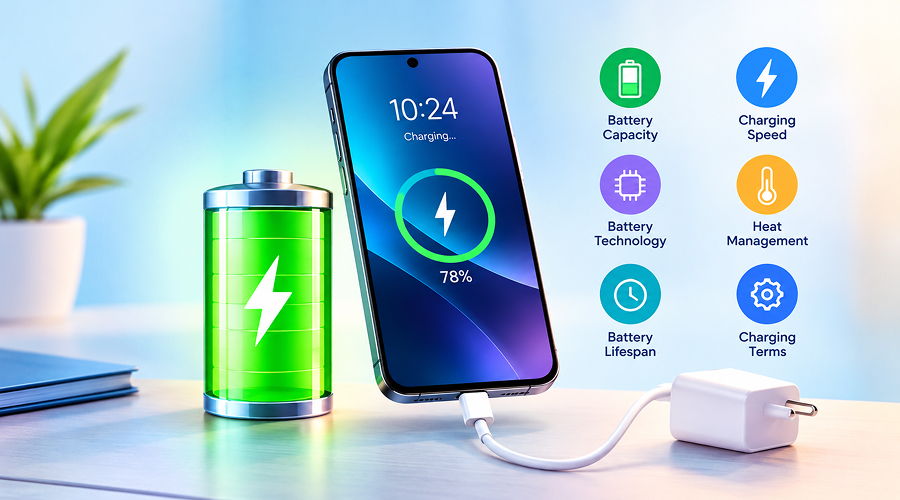
A good battery is essential for a great smartphone experience. That’s why brands now offer larger batteries, faster charging and advanced technologies such as silicon-carbon. However, battery performance depends on more than its capacity and charging speed. If you want to understand smartphone battery and charging in detail, then read this post. This guide explains key battery and charging terms and how they affect everyday use. Let’s dive in…
Why Battery Specs Are More Confusing Than They Should Be
Smartphone battery specs may look straightforward; but they involve more than just numbers. You may often see details such as:
- 4080mAh battery
- 5,000mAh battery
- 6,000mAh battery
- 7, 000mAh battery
- 67W fast charging
- 100W fast charging
- 50W wireless charging
- Silicon-carbon battery
- USB Power Delivery
- Battery health at 90%
Battery specifications can be confusing because mAh measures battery capacity, while watts indicate charging speed. However, a smaller battery may last longer due to better efficiency, and faster charging isn’t always necessary.
Battery Capacity (mAh) Explained
Here is everything you need to know about battery capacity. Take a look…
What mAh Means
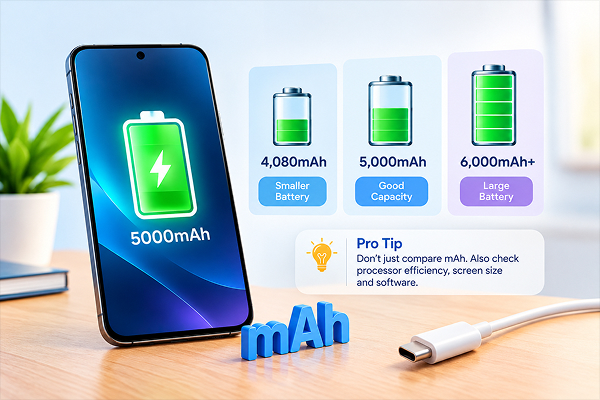
mAh stands for milliampere-hour. It is basically a measurement of a battery’s electrical charge capacity. It gives you an idea of how much charge the battery can hold. For example, 4,080mAh is a smaller battery, 5,000mAh is a good capacity, and 6,000mAh or more is a large battery. A bigger battery can undoubtedly, store more charge, but it doesn’t always mean longer battery life.
Moreover, mAh doesn’t tell you the total energy stored in a battery by itself. Voltage also matters. Battery energy is more directly expressed in watt-hours (Wh).
Pro Tip: Pay attention to processor efficiency, screen size and software, instead of just comparing similar phones based on mAh.
Why Higher mAh Doesn’t Always Equal Longer Battery Life
A common mistake that most buyers make is assuming that a phone with a bigger battery always lasts longer. For example, a phone with a 6,000mAh battery may seem to last longer than one with a 5,000mAh battery. But in reality, that’s not how it works. Real-world battery life depends on how much power the phone consumes. If the phone has a power-hungry display or processor, it can use considerable power.
You will be surprised to know that a phone with a 6,000mAh battery may last as long as one with a 5,000mAh battery if it has a larger display, a powerful processor and 5G connectivity that use more power. Therefore, it is crucial to pay attention to battery efficiency as well, along with battery capacity.
Battery Technology Types Compared
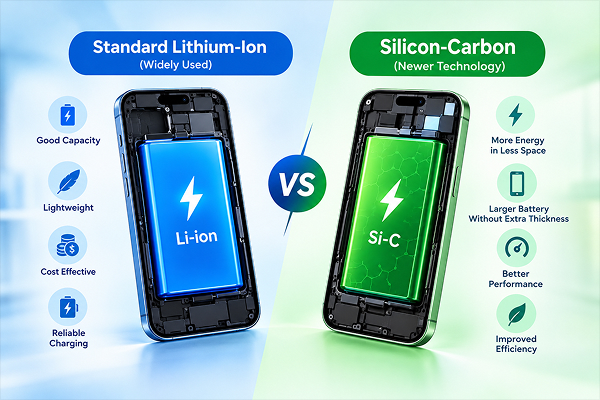
The battery technology used in a phone also matters. There are mainly two types of batteries used in the phones: standard lithium-ion batteries and newer silicon-carbon batteries. Check out the details…
a. Standard Lithium-Ion
Lithium-ion batteries are widely used in smartphones because they offer a good balance of capacity, size, weight, cost and charging performance. Moreover, they store energy when charging and release it during use. However, increasing their capacity usually requires a larger battery or a different design.
b. Silicon-Carbon Batteries
Silicon-carbon batteries are a newer development in smartphone battery technology. Ther are meant to store more energy in less space than traditional batteries. This allows manufacturers to offer larger batteries without making phones thicker. However, actual battery life depends on the phone’s design and power efficiency.
How Long Should a Phone Battery Last Per Charge?
It depends on individual’s usage patterns. Someone who uses his device only for checking WhatsApp messages, reading emails and making occasional calls may get well over a day. However, a heavy user who plays demanding gaming, records videos, streams online content and uses 5G may need to charge before the day ends.
So, instead of focusing only on battery life in hours, consider screen-on time and your daily usage. Most modern smartphone makers are launching phones that can last a full day, while some have even launched phones with larger batteries and efficient hardware that can last much longer.
Factors That Affect Real-World Battery Life
There are several factors that affect real-world battery life, some of them are as follows:
- Display: The display uses a lot of battery power. Screen size, brightness, resolution, and refresh rate all affect battery life. Undoubtedly, a 120Hz screen offers smoother scrolling but also uses more power than a lower refresh rate.
- Processor: A modern processor undoubtedly makes a phone fast, but at the same time its efficiency affects battery life too. However, a newer processor can offer better performance while using less power than an older one.
- Network Connection: 5G undeniably offers speed, but it also consumes more power in certain situations, especially when the network signal is weak or unstable. This is because a poor signal makes the phone work harder to maintain a connection.
- Applications: Social media, navigation, video and gaming apps consume a lot of power. Besides that, certain apps keep working in the background even when you aren’t actively using them.
- Camera: Taking photos uses little battery, but recording long 4K or high-resolution videos drains more power because several phone components work together.
- Temperature: Variations in temperature, such as very hot or very cold conditions can affect battery performance. You should always avoid high temperatures while charging or using your phone heavily.
What Drains Battery Fastest
Here are the top reasons; take a look…
- Gaming
- Video recording
- High screen brightness
- Long video streaming sessions
- GPS and navigation
- Mobile hotspot use
- Poor cellular signal
- High refresh rates
- Background apps
- Intensive 5G use
The exact impact may vary from phone to phone.
Charging Speed Explained
Charging speed has become one of the biggest selling points of modern popular smartphones. Many smartphone makers advertise their devices with 33W, 45W, 67W, 80W, 100W or even higher charging speeds.
But what do these numbers actually mean?
What Wattage Actually Means
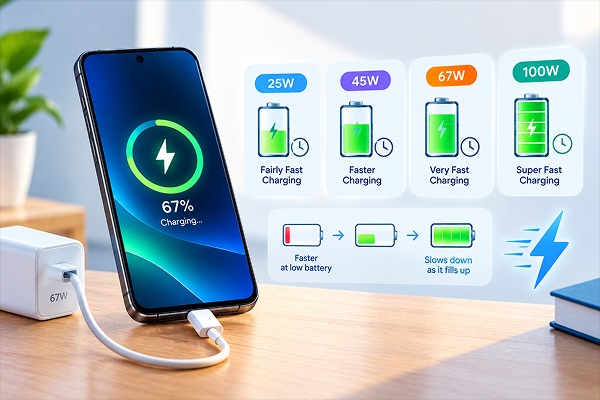
Watt (W) actually measures power. Higher wattage, simply means the phone can receive more power while charging. For example, 25W charging is fairly fast, while 45W, 67W, and 100W offer faster charging. However, a phone won’t charge at its maximum speed from 0% to 100%.
Know that charging speed changes during the charging process. A phone charges faster when the battery is low and slows down as it fills up to control heat and protect the battery. So, 100W charging isn’t always four times faster than 25W charging.
Wired vs Wireless vs Reverse Wireless Charging
Here is how they all differ:
1. Wired Charging
Wired charging is the most common and usually the fastest way to charge a phone. It offers faster charging, better power efficiency, less heat in many cases and easy access to chargers.
2. Wireless Charging
Wireless charging, on the other hand, allows users to charge their phones by placing them on a compatible charging pad instead of connecting a cable directly. Wireless charging is undoubtedly convenient, but it can be slower and produce more heat than wired charging. Additionally, fast wireless charging also requires a compatible charger and accessories.
3. Reverse Wireless Charging
Reverse wireless charging turns your phone into a basic wireless charging pad. You can use your device to charge compatible accessories such as your wireless earbuds or another smartphone (has to be supported). It is useful when you need a quick emergency charge, but it’s not usually the most efficient way to charge a device.
Fast Charging Standards (VOOC, SuperDart, USB PD, etc.)
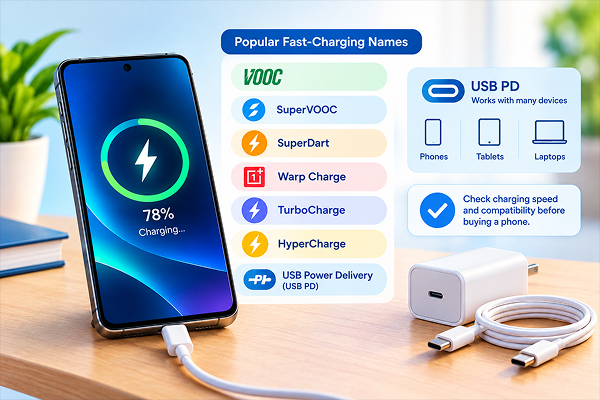
Different smartphone brands use different charging technologies and names. Some of the popular names include:
- VOOC
- SuperVOOC
- SuperDart
- Warp Charge
- TurboCharge
- HyperCharge
- USB Power Delivery (USB PD)
Fast-charging names can be confusing. Some brands use their own chargers and cables to achieve higher charging speeds. However, USB Power Delivery (USB PD) is a common standard. It works with many phones, tablets and laptops. When buying a phone, check its charging speed and whether your charger is compatible. This is because the phone, charger and cable must all support the required charging system to achieve the advertised speed.
Battery Health and Longevity
A smartphone battery loses capacity over time with regular use, no matter how advanced your phone is or how well you maintain it. Its battery will gradually lose some of its original capacity.
How Batteries Degrade Over Time
Lithium-based batteries lose capacity with repeated charging and use. Over time, they store less power, so older phones need more frequent charging. Heat can speed up battery ageing; therefore, you should avoid exposing your phone to high temperatures for long periods.
How to Check Battery Health
The way you check battery health depends on the phone itself. Some devices allow you to check battery health in your phone’s Settings. iPhones show battery health under Battery settings, while Android phones offer different battery health and diagnostic options depending on the brand. If your phone doesn’t show a battery health percentage, then here are the signs you can look for:
- Much shorter battery life than before
- Unexpected shutdowns
- Rapid percentage drops
- Excessive heating
- Very slow charging
- Consistent charging problems
If you notice all or some of these signs, then consider getting your battery replaced by a professional service provider.
Does Fast Charging Damage Battery Health?
Fast charging does not automatically damage your battery. Modern phones are designed to control charging speed and temperature that protect the phone’s battery. However, heat often speeds up battery ageing. Hence, you are advised to avoid charging your phone in hot places or under a pillow or blanket. You can still use fast charging safely while taking care to prevent overheating.
Battery Specs That Are Marketing vs Battery Specs That Matter
Modern smartphones come with numerous battery specifications. However, not all of them needs to be paid attention to. Some numbers look impressive on a phone’s specification sheet but don’t tell you much about everyday experience.
The Specs That Matter the Most
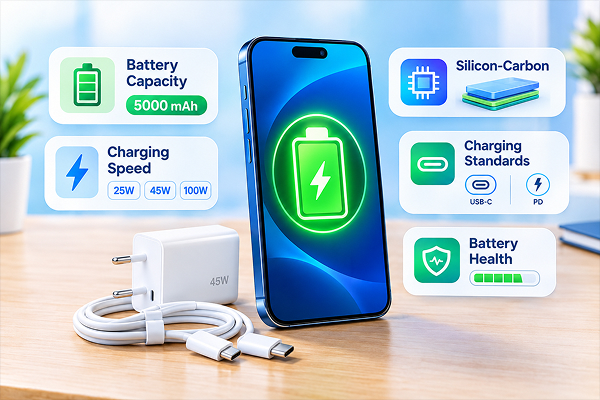
Here are the most important ones; take a look…
- Battery Capacity: A bigger battery can last longer, especially when paired with power-efficient hardware.
- Charging Speed: A useful feature for those who frequently need to recharge their phones during the day.
- Battery Technology: Modern Silicon-carbon batteries fit in small spaces, making is easier for manufacturers to offer higher capacity in a relatively compact design.
- Charging Standards: It could be important for users who want to use their existing chargers and accessories.
- Battery Health Features: Features that manage charging and temperature are also important as they help with long-term battery care.
Specs That Are Marketing
Here are some of them; take a look…
- Huge mAh Numbers: A bigger battery doesn’t always last longer. The display, processor, software, and network usage also affect battery life.
- Very High Charging Wattage: A 100W or 120W charger sounds fast, but actual charging time depends on battery size, temperature, and the charger’s performance.
- Fast Wireless Charging: It is convenient, but wired charging is generally more effective and efficient.
Pro Tip: You are advised to look at the real-world performance and efficiency, instead of just paying attention to higher mAh and wattage.
Putting it all together…
So, there you have it: the complete guide on smartphone battery and most important charging terms. Modern smartphones come with larger battery capacities, faster charging and better efficiency. However, it is worth noting that battery life doesn’t simply depend on more mAh and higher charging speed. The processor, display, battery technology and usage habits also matter a lot.
So, when you buy a phone, pay attention to real-world battery life, charging time and long-term performance rather than just the biggest battery or highest wattage. This way you would be able to choose a phone that suits your daily needs and get the most out of your smartphone.