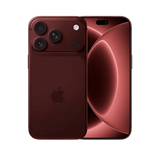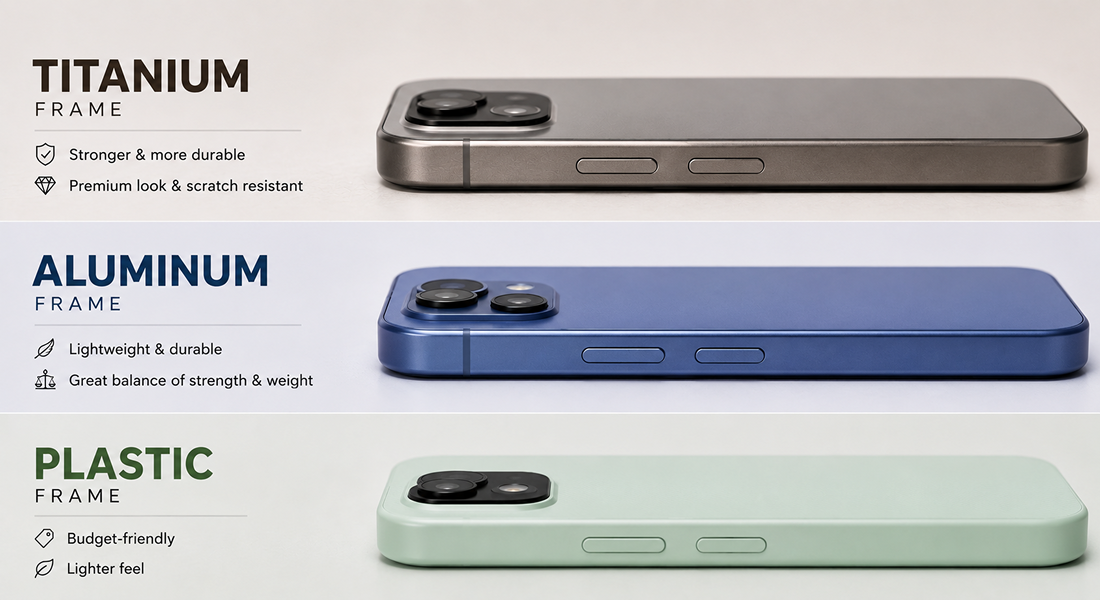
Phone makers spend marketing dollars to convince you that their frame material is the best. Titanium is touted as a breakthrough innovation. Aluminium is hailed as an exacting engineering triumph. Plastic is vouched as a sensible choice. The timepiece frame material battle between titanium vs aluminum has objected since premium devices started making material selection a prominent feature. But does the substance surrounding your phone really matter? This smartphone material comparison to build your smartphone reveals that by providing you with answers that are data driven, not DRAM driven.
The Three Most Common Phone Frame Materials
Before we jump into comparing these materials directly, it’s important to understand what each actually is and why manufacturers choose to use it. This provides crucial context for every comparison that follows.
1. Titanium
Titanium is the supreme but costly strong lightweight metal, used primarily in aerospace, motorsports and medical implants, and featured in smartphones for the first time in the iPhone 15 Pro. It’s a tough metal used in premium smartphones like the Samsung Galaxy S24 Ultra for resilience and premium feel.
2. Aluminium
Aluminium has been the premium smartphone frame of choice for 10 years, because it is cheap, durable, shred-resistant and easy to fabricate with. 6000 or 7000 series aluminium alloys (reinforced) are used by most flagship smartphones for added impact resistance.
3. Polycarbonate
Most mid-range or budget smartphones use polycarbonate plastic, which is cheap and lightweight, but it can also be reinforced (glass fibre reinforced polycarbonate) for better impact resistance.
Side-by-Side Comparison Across What Matters
Durability and Drop Resistance
Does the phone’s frame material impact drop resistance?
Yes, a phone’s frame material influences how it distributes impact force when dropped. A stiffer frame can protect itself but would transmit more force to its glass surface, while a more flexible frame can absorb more impact.
- Titanium is very, very strong and doesn’t dent, but it’s rigidity means that it can’t absorb impact any more. This means it can actually be more prone to the front or rear glass getting cracked if you drop your phone hard.
- Aluminium is more likely to bend or dent to absorb some of the impact. Though this will deform, it can actually help absorb some of that impact from getting into the glass.
- Polycarbonate is flexible, shock absorbing, so it is very drop-resistant. That is why many plastic phones can take a harder drop and still survive than many more “premium” devices.
IP68 doesn’t measure drop resistance, it’s just an indication of the sealing quality of the phone, and therefore whether it can resist water and dust to a certain extent. It says nothing about impact resistance of the frame material.
| Frame Material | Scratch Resistance | Impact Absorption | Deformation Risk |
| Titanium | Excellent | Low | Very Low |
| Aluminium | Good | Moderate | Moderate |
| Polycarbonate | Poor | High | Low |
Weight and Feel in Hand
A phone’s weight and feel in hand matters a lot.
Titanium is good at a high strength-to-weight ratio which allows manufacturers to go thin while still being strong. So it can ultimately be lighter without losing strength.
Aluminium is a bit heavier but tends to feel solid, and premium. That is for many people the preferred feeling.
Polycarbonate (plastic) is the lightest of all the materials which makes phones comfortable to hold for long periods. But they might not always feel so premium or they might even feel a bit hollow unless equipped with a robust internal chassis.
Overall titanium is the lightest and strongest material, aluminium gives a premium feel that is also solid and sturdy, while polycarbonate gives great comfort and a low price.
Heat Dissipation
Smartphones should be able to cope with gaming, video, and other highly demanding tasks which consume a lot of heat. Efficient heat dissipation means phones don’t underperform by throttling down during hard tasks.
- Aluminium is a great heat conductor which means it can quickly absorb and disperse heat – allowing phones to heat up quickly and stay hot for longer.
- Titanium is not as good a heat conductor and this means phones can suffer thermal throttling during heavy tasks.
- Polycarbonate is a poor heat conductor and this means it doesn’t transfer heat well and acts more like an insulator. Phones at the cheaper end either don’t overheat or use CPUs/GPUs with lower heat dissipation and flagship plastic phones depend heavily on advanced cooling such as vapour chambers.
Overall aluminium gives the best heat dissipation, titanium is strong but can overheat and polycarbonate depends heavily on its internal components to handle heat.
Price impact
The type of material a smartphone is made from has a direct impact on manufacturing costs and retail price. Titanium, which is the most expensive, is difficult to source and machine and requires specialised tools and manufacturing processes. It is therefore typically used for premium flagship smartphones with a price of £999 and up. Aluminium, which is cheaper, more available and easier to produce on a large scale, is rather more common and is used for most mid-range and premium smartphones in the £400-£900 price range.
Polycarbonate, being the cheapest, can be mass-produced quickly using injection moulding, allowing manufacturers to offer affordable smartphones in the £100-£350 price range. These savings can then be re-directed towards better cameras, larger batteries or more powerful processors.
Does Frame Material Affect Antenna Signal Strength?
It’s called Antennagate, and it’s not just an iPhone marketing scare. The huge material difference between aluminium and titanium has traditionally made metal models fail to transmit high-frequency signals, the way mesh antennas transmitted signals through a mesh of wires. Antennagate was fixed by putting in little breaks in the metal, so air or plastic would fill the gaps in the antenna holding region. This is technology that has been used in mobile devices for 15 years now, and is now being used in the iPhone 16 Pro’s titanium frame (see SDR video below), and Samsung’s metal-framed smartphones. The latest trend are antenna bands. You can see where the antenna is in the aluminium-framed Samsung S23 Ultra and this still allows decent signal on both frequencies, even if you don’t have any idea what’s happening.
Putting antenna breaks into aluminium isn’t always easy. The iPhone 7 broke this rule, putting the antenna all over the back, and having to use it non-deterministically. And it’s amazing how poorly the iPhone has handled the next generation of 5G, especially the mmWave frequencies, which have a much higher attenuation than the sub-6GHz frequencies. These mmWave frequencies, with their very short wavelengths, are especially problematic because most metal exceeds the 1mm wavelength. A cheap plastic front is a better antenna for wireless charging.
The new silicon carbide 5G antennas aren’t great, they’re not related to the problem directly, but it shows people are interested. It’s just not necessary for polycarbonate. It’s radio frequency transparent, which means it’s best for modern wireless charging, but it also solves the mmWave reception problem. And it’s clear that signal quality is more about antenna engineering than the material that the phone is put together out of.
Is Titanium Worth the Premium Over Aluminium?
This is the question most relevant to buyers evaluating premium phone build quality 2026 flagships represented across the market.
Titanium delivers genuine advantages in scratch resistance, structural rigidity, and weight reduction at equivalent strength. The premium feel and the association with aerospace-grade materials carries real psychological value for buyers who will use and handle their device daily for two or more years.
However, the practical daily experience difference between a well-made aluminium flagship and a titanium flagship is subtle rather than transformative for most users. Aluminium scratches slightly more easily, weighs marginally more, and dissipates heat more effectively. Titanium scratches less, weighs marginally less at equivalent structural strength, and retains heat more locally. Neither material advantage is decisive for typical smartphone usage patterns.
Where titanium justifies its premium convincingly is longevity. Scratch resistance means a titanium-framed device maintains its appearance over extended ownership periods without the visible wear that aluminium accumulates after twelve to eighteen months of daily handling. For buyers who keep phones for two to three years without cases, this sustained appearance quality represents genuine value.
For buyers who use protective cases, the frame material becomes largely academic. A cased aluminium phone is practically indistinguishable in daily use from a cased titanium phone, making the material premium irrelevant to the actual ownership experience.
The Bottom Line
Frame material genuinely affects your smartphone experience, but not equally across all usage scenarios.
If you care about scratch resistance, marginal weight reduction and long-term appearance quality on a device you plan to use without a case for multiple years. You must choose titanium. Accept that you will pay a significant premium and that heat dissipation is a relative disadvantage with which to live.
If you want premium build quality, excellent thermal management, and broad availability across flagship and upper mid-range price points. Aluminium remains the rational premium choice for the majority of buyers.
If budget is the primary constraint, if drop resistance matters more than scratch resistance, or if 5G mmWave signal performance is a priority. Modern polycarbonate implementations are significantly more refined than their reputation suggests and deliver genuine value at their respective price points.
The marketing drama surrounding frame materials may be real, but the actual daily difference is not. Your processor, camera system, software support timeline, and battery capacity will influence your daily experience far more meaningfully than whether your frame is titanium, aluminium or polycarbonate. Before buying, you can also compare phones based on their specifications, build quality and overall features rather than choosing a device solely for its frame material.