Smartphones have become an integral part of our daily lives. Still, sometimes it becomes difficult to choose the right phone. Most times people focus on the processor, camera, battery and display and often forget to pay attention to the storage technology. Oftentimes users overlook storage technology because it sounds too technical to them. But you will be surprised to know that this overlooked aspect plays a crucial role when it comes to have fast and smooth performance.
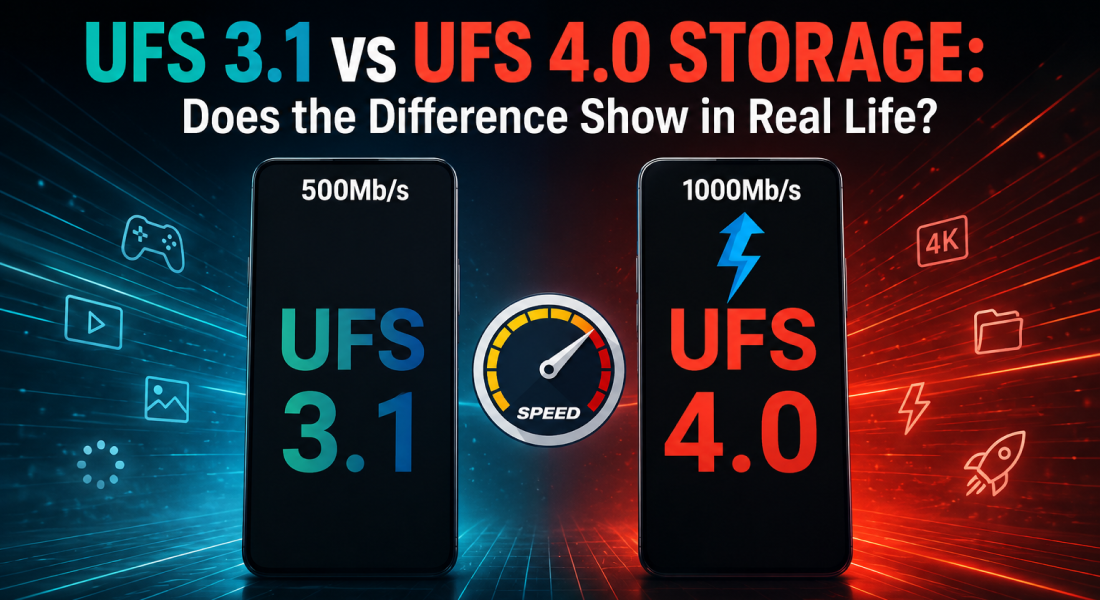
Today, most of the smartphone brands market their phones, including popular devices, with UFS 3.1 vs UFS 4.0 Storage. Of course, understanding the difference between these two may feel a bit overwhelming for users. But fret not! In this post, we will discuss how UFS 3.1 vs UFS 4.0 storage technologies differ and which one is better and why. So, let’s dive in…
Understanding UFS 3.1 and UFS 4.0 Storage Technology
UFS stands for Universal Flash Storage. Modern smartphones come with this technology so as to ensure safe storage of your photos, apps, videos and files. UFS 3.1 and UFS 4.0 are both storage technologies that allow you to keep all your apps, photos, videos and files in one place. UFS 4.0 is the latest generation storage technology, while UFS 3.1 is its predecessor. The faster storage ensures your phone can quickly access information whenever you need.
Among several storage technologies, the newer standard, which is UFS 4.0 offers significantly higher read and write speeds. In simple terms, it is capable of moving data around much faster compared to UFS 3.1. In addition, it is also more power-efficient. This means that the more advanced storage standard can complete tasks without consuming too much energy.
UFS 3.1 vs UFS 4.0: What’s the Difference?
Of course, when we talk about the differences between these two storage standards, especially when we compare modern smartphones, the first question that comes into mind is whether upgrading to the newest standard matter?
Let’s understand whether it does or not. Here we go…
1. App Opening Speed
One of the first areas where storage speed matters is app loading. After comparing two similarly powerful smartphones (one with UFS 3.1 and another with UFS 4.0), we can say that the one with UFS 4.0 opens some apps slightly faster. However, the difference is usually measured in fractions of a second.
Undoubtedly, upgrading to UFS 4.0 may make some of your applications, including social media apps, messaging apps, web browsers and music streaming apps launch a little faster. However, you will not be able to notice much difference during normal use. This is because UFS 3.1 also does the job pretty well.
2. Gaming Performance
More often than not, gamers assure that faster storage can automatically improve gaming performance. But that’s not how it is.
If you also think so, then you should know that the processor and graphics hardware play a crucial role when it comes to better frame rates. Storage mainly affects how quickly a game loads.
You may notice that a large game loads a bit faster on a phone with UFS 4.0 storage. However, you won’t see any different while playing the game as both phones will deliver similar gaming experience. So, if you are a hardcore gamer, it’s wise to focus more on the processors rather than just focusing on the storage standard.
3. File Transfers and Downloads
File transfers and downloads are areas where you may see a significant difference. Since, storage technology mainly plays a role here. Those who use their devices for transferring large videos, downloading huge game files or moving data between devices will find a significant difference.
UFS 4.0 smartphone can help them transfer data much faster than a phone with UFS 3.1. That’s the reason more and more content creators, mobile videographers and power users prefer UFS 4.0 devices.
4. Multitasking Experience
Modern smartphones constantly move data in the background while running multiple apps. Because UFS 4.0 handles this data more efficiently, it can help the phone feel a little smoother when many apps are open at once. But it is worth noting that higher storage standard is not the only criteria that ensures smoother multitasking experience. Your phone should also include a powerful processor. Without that, you will not be able to notice much difference.
In simple terms, a phone with a powerful processor and UFS 3.1 storage makes a better choice than the one with weaker processor and UFS 4.0.
5. Battery Efficiency
When it comes to battery efficiency, then UFS 4.0 stands out. As you know the latest storage standard can move data faster while using less power. This helps save battery life. However, the improvement is usually small and difficult to notice. Still, display brightness, processor efficiency, network usage and battery capacity play a much bigger role in determining how long your phone lasts on a single charge.
Who Should Choose UFS 4.0?
UFS 4.0 makes the best choice for those use their devices for:
- Recording and editing large videos.
- Transferring huge files.
- Playing large, graphics-intensive games.
- Creating professional level content.
Besides that, users who buy their devices for long-term use can also consider opting for a device with UFS 4.0. The faster storage technology ensures long-term benefits for such users.
However, the ones looking for a device just for daily activities, such as social media, video streaming, web browsing, photography, online shopping and casual gaming, a phone with UFS 3.1 storage makes a perfect choice. The experience with UFS 3.1 will still be smoother and reliable.
The Bottom Line
So, there you have it: the difference between UFS 3.1 and UFS 4.0 storage. Undoubtedly, the UFS 4.0 is a more advanced storage technology than UFS 3.1. It offers faster speeds, better efficiency and improved handling of large files; however, the difference may not be significantly noticeable for most users. Average smartphone users may not require a more advanced storage standard. They can instead choose to go with a well-optimized phone with UFS 3.1 storage.
These phones can still deliver an excellent experience and ensure faster and smoother app launches, social media browsing, video streaming and everyday multitasking. Do consider your usage prior to opting for a device. Do not just opt for a device with a more advanced storage standard; instead, look for other aspects as well, which include processor model, RAM capacity, battery size, display quality, software optimization and camera performance for an outstanding user experience!