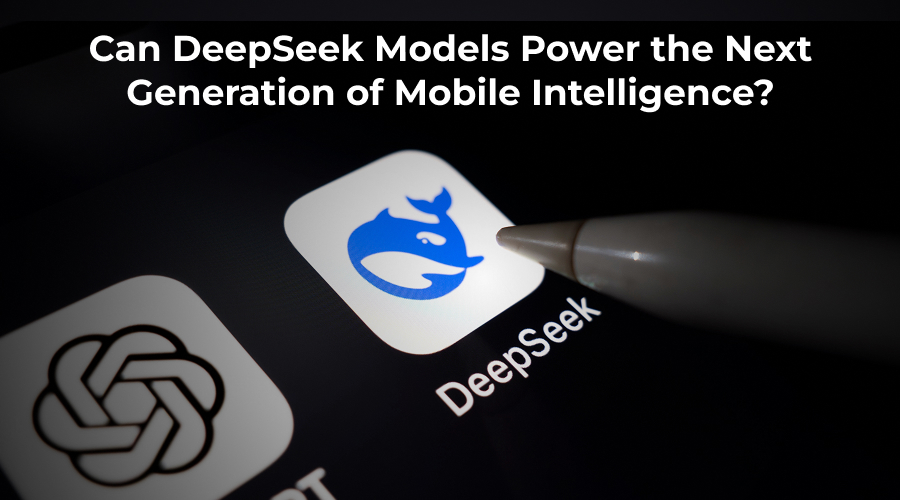
First released in November of 2023, China’s DeepSeek has unveiled two new versions of an experimental artificial intelligence (AI) model on December 1, 2025. The new models that DeepSeek released include two new AI models called DeepSeek-V3.2 and DeepSeek-V3.2-Speciale. Both of these experimental AI models include some fresh capabilities that are sure to help with combining reasoning and executing certain actions autonomously. These two models are in direct competition with OpenAI and Google. However, the question here is whether the DeepSeek models can power the next generation of mobile intelligence or not? Let’s know it in this post. Let’s get started…
Before we delve deep into the post, let’s first understand what Mobile Intelligence is. Here we go…
What is “Mobile Intelligence?”
“Mobile intelligence” refers to a broad set of abilities that are included in smartphones these days. These abilities often include, real-time speech recognition, natural language understanding, image/video processing, on-device assistance (such as text suggestions, predictive typing, content generation), gesture recognition, contextual adaptation (like battery saving, personalized settings) and creative generation (such as photos, text, artwork). Most modern mobiles come with On-Device AI to help users with instant responses, preserve privacy and so on.
Can DeepSeek Models Power the Next Generation of Mobile Intelligence?
The quickest answer to this is YES! Yes, DeepSeek models are sure to drive the next generation mobile intelligence. According to the Chinese AI startup, DeepSeek is a next-generation AI model built to run efficiently on mobile devices. If optimized properly, they can deliver real-time, low-latency AI experiences directly on-device. In addition, they are designed to enhance privacy. With the new DeepSeek AI models, there will be no need to upload personal data to the cloud. This will further enhance user experience and ensure privacy. Aside from that, these models are designed to offer offline functionality – even if working in low-connectivity settings or privacy‑sensitive environments.
DeepSeek’s latest AI models are designed for modern smartphones, enabling creative apps, AR/VR, smart cameras, personal AI assistants and more. All in all, DeepSeek models have a strong potential to power the next-gen mobile intelligence.
Core Aspects of DeepSeek AI Models
Here are some important aspects that back this development; take a look…
- Efficient Architecture: DeepSeek AI models are built on an innovative Mixture-of-Experts (MoE) architecture. This innovative architecture allows the models to achieve high performance while only using part of its full system for each task. This helps save processing power and battery, which is very important for mobile devices.
- Model Distillation: DeepSeek has developed a method to “distill” or we can say “shrink” the reasoning capabilities or intelligence of its larger, more powerful models into much compact, more efficient models. These compact models are capable of running locally on a mobile device’s processor, leading to enhanced performance.
- On-Device Capabilities: DeepSeek AI models, such as DeepSeek-R1:1.5b that can be run on Android devices using tools like Termux and Ollama demonstrates practical on-device inference capabilities. Some users even tested with DeepSeek AI models and found the version working at par with Gemini 3 and GPT 5. For ML tasks, DeepSeek models may not be working as good as other AI models; however, for other tasks, such as Maths, the v3.2 base turned out to be slightly better than Gemini 3 pro. The availability of DeepSeek AI enables offline functionalities as well and also helps preserve data without relying on cloud connectivity.
- Industry Integration: Some of the Chinese brands, such as Huawei, Oppo and Honor have already started integrating DeepSeek AI into their mobile phones. These brands are incorporating the DeepSeek-R1 model into their devices to enhance the On-Device AI capabilities and other smartphone functions. Aside from that, the DeepSeek AI models are also integrated in consumer electronics, including smart TVs, robotic vacuum cleaners and other products for on-device intelligence. This simply implies that the DeepSeek AI is meant for multiple edge AI tasks, and are not just limited to smartphones.
- High Performance for Size: DeepSeek models are designed to offer “high performance for size.” The unique architecture (Mixture-of-Experts) and efficient hardware-software co-design allows for robust performance. Compared to other open-source AI models of the same size, DeepSeek AI stands out for its high performance and computational efficiency.
- Cost Effectiveness: Cost-effectiveness is yet another important aspect that allows brands to integrate DeepSeek models into the next-gen mobile devices. The Chinese AI startup offers way too cost-effective AI models compared to other popular open-source AI models, such as ChatGPT. This again makes DeepSeek models much desirable options for mobile intelligence.
Other Aspects
- Mobile Hardware: Rapid improvement in mobile hardware, such as integration of NPUs, AI accelerators and optimized SoCs are all making it easier for brands to incorporate AI capabilities into mobile phones, even on the mid-range devices.
Privacy Concerns: Users are now more concerned about their privacy than ever. And this significantly gave rise to the incorporation of AI models, such as DeepSeek to allow users to preserve privacy. - AI-Capabilities: More and more phone brands are now focusing on On-Device AI capabilities to enhance user experience. This surge simply signifies the increased use of DeepSeek AI models in next-gen smartphones.
The Bottom Line
So, this is all about whether or not DeepSeek models can power the next generation of mobile intelligence. Hopefully, this article helps you learn that the DeepSeek models are sure to drive next-gen mobiles. DeepSeek’s deep learning models along with optimized architectures are sure to turn “mobile intelligence” into a reality. This implies that users can expect to have faster, smarter and more privacy-focused smartphones.
Early adoption may be slow because of new technology, limited resources and varying devices; however, improvements in compression, hybrid edge–cloud systems and mobile AI support may help mitigate these challenges. The near future is going to be swamped with truly intelligent mobile devices powered by DeepSeek models, providing users with improved privacy and excellent user experience.