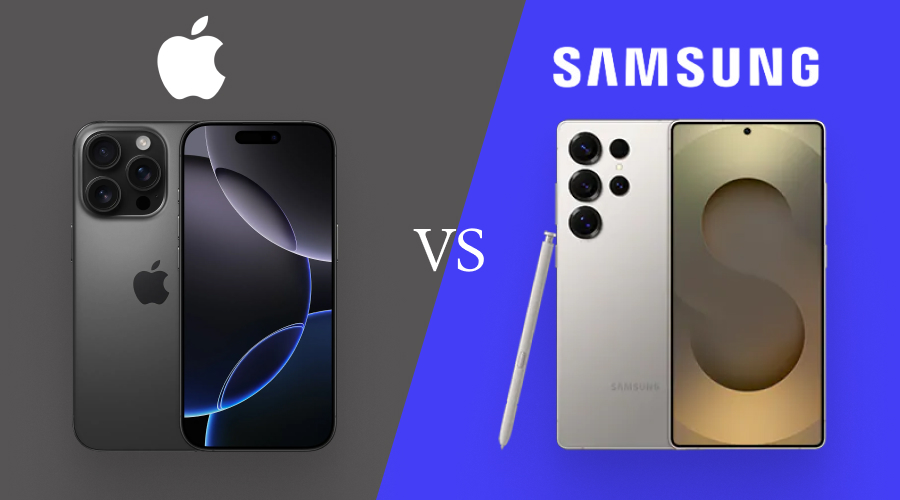
Competition among business giants or brands is pretty common in this era. Of course, each brand to stay ahead. Among several brands, Apple and Samsung are two of the biggest names. Both the brands are into consumer technology and are often seen as fierce competitors. However, their relationship is more complex than just competition.
Behind the scenes, both companies rely on each other in certain ways, which shows that competition and collaboration can exist at the same time. When it comes to the ranking of these two brands, Apple always rank as the world’s most valuable brand. And why not? Apple had 25% of market share in 2025. Samsung, on the other hand, has 19% of market share, even though both the brands sold equal units of goods (devices).
So, what’s the reason Apple is ahead in the competition? Read this guide for complete comparison of the smartphone giants. Let’s dive in…
Apple vs. Samsung: Rivalry in the Smartphone Market
Apple and Samsung are both globally recognized tech brands and are also known for a strong rivalry in the smartphone market. Both have created strong brand loyalty; however, their approach and strategies are different in many ways. Each brand ships hundreds of millions of phones every year, usually between 240 and 250 million devices worldwide.
However, their revenue models are different. Apple follows a luxury-style strategy as it focuses on premium pricing and a high-end experience. The brand delivers high-end devices, including the iPhone, Mac, iPad, and Apple Watch and mainly focuses on innovation, privacy, performance, simplicity and user-focused experiences. Even if Apple sells less devices than Samsung or any other phone brand, it ends up making more money. The strength of apple brands lies in their ecosystem and premium positioning.
Samsung, on the other hand, uses a different approach. The brand offers smartphones, smart TVs, home appliances and semiconductors. It particularly offers smartphones across many price ranges in order to reach larger audience with different needs and budgets. Undoubtedly, both Apple and Samsung follow amazing strategies, but their financial outcomes differ significantly.
Apple vs Samsung: Financial Snapshot (2025)
| Category | Apple | Samsung |
|---|---|---|
| Market Leadership | Shipped around 243 million units | Shipped somewhere around 235 million units |
| Market Share | Captured a record 25% global shipments | Held around 19% global shipments |
| Revenue & Value Share | Expected value share of about 28% | Value share remains around 22% |
| Net Profit | $112 Billion | $31 Billion |
| Strategic Focus | Premiumization, expansion of 5G adoption and growing active installed base | Premium Galaxy S/Fold lineup plus A-series mid-range devices to maintain volume |
| Performance Drivers | Benefited from approx. 10% sales growth in 2025 | Growth supported by approx. 5% increase in shipments, driven by foldable and 5G models |
The snapshot above shows a contrasting difference between their net profit. Both the brands sold almost same number of phones and even have close value shares, but their revenue and profits are very different. Apple earns almost four times more net profit than Samsung. The brand leads in Leads in profitability due to higher Average Selling Prices (ASPs); however, Samsung may have lower profitability compared to Apple but the brand stands out for its strong volume-driven strategy.
Apple vs. Samsung: How These Brands Make Money
Apple’s success largely revolves around its devices, especially the iPhone. Apple sells computers, tablets and smart watches, in addition to Apple iPhones. However, each year, Apple’s iPhone account for more than half of Apple’s total revenue, which is followed by MacBooks and iPads. In 2025, Apple’s total revenue was approximately $416 billion and net income was $112 billion. The iPhone was the main source of profit, generating around $209.59 billion in revenue and contributing more than half of the company’s total earnings.
Samsung, on the other hand, makes money by selling diverse products at varied price points. The company operates mainly through two divisions: device experience and device solutions. The device experience division includes everyday consumer technology, such as smartphones, laptops, televisions, home appliances and other electronics.
The device solutions division focuses on the technology behind the scenes, such as semiconductors, memory chips, integrated circuits, displays and other components that power modern devices. Samsung’s smartphones are widely popular and contribute heavily to its overall revenue each year.
However, a significant portion of its operating profit also comes from its semiconductor business. In 2025, Samsung recorded total revenue of $233.3 billion, out of which major portion came from smartphone and semiconductor sales.
Apple vs. Samsung: Profit Strategies
Both Apple and Samsung have different approaches when it comes to profit strategies. Apply focuses on premium prices and high margins, whereas, Samsung follows a diverse business model. So, even when Apple sells fewer devices in a year, it makes more money than its competitors, including Samsung.
Apple focuses on premium pricing and high margins. Even though it may sell fewer smartphones than Samsung, it earns more profit per device. Apple’s gross margin reached over 46.9% in fiscal year 2025, making it the top contender to generate profit from each sale. Samsung, on the other hand, sells diverse products, including smartphones, consumer electronics and semiconductors.
Its semiconductor division plays a major role in driving profits. In 2025, roughly 81.7% of Q4 operating profit of Samsung came from semiconductor division.
Apple vs. Samsung: Rivalry Beyond Retail Spaces
Apple and Samsung are famous not only for their rivalry in the market, but also in the legal battles. Over the years, both the brands have indulged in several high-profile legal battles, particularly around smartphone design and technology patents.
It all started in the year 2011 with a patent war, when Apple accused Samsung for allegedly copying iPhone designs and user interfaces. The legal battle lasted seven years, with both companies filing many lawsuits worldwide, with major financial settlements and rulings over the years. Despite these conflicts, both companies continue to compete fiercely in the global smartphone market.
Apple vs. Samsung: Collaboration
There is no doubt that both brands are driving competition and innovation in the smartphone market. They compete fiercely in the global smartphone market but at the same time the two even collaborate. Samsung is one of the key suppliers for Apple’s iPhone components. Samsung supplies high-quality OLED panels for iPhones and is expected to provide screens for the upcoming foldable iPhone, showcasing that competition and collaboration can exist at the same time.
A wide range of Samsung brands further strengthens this collaboration, as Samsung continues to supply components and technology that help Apple maintain its premium product quality.
Apple vs. Samsung: The Bigger Picture
Apple and Samsung are competitors but there are times when they collaborate, demonstrating that competition doesn’t always mean separation. Both companies have gained immense popularity in the global smartphone market, yet they collaborate in certain areas benefiting each other and featuring the value of strategic partnerships. No matter how different their strategies are; they work well for them.
Apple focuses on higher profits, while Samsung focuses on reaching more customers. One leads in the premium segment, while the other targets a wider market. All in all, both rivals are the epitome of innovation, shaping the future of the global smartphone industry both independently and together!