Smartphone cameras have become a major factor when choosing a phone. But most people often have no idea what camera features they should look for. Moreover, specs like 200MP cameras, 3x optical zoom, OIS and 8K video make it harder to make the right choice. So, what really matters when choosing a smartphone camera? Read this post for the answer.
This guide explains the key smartphone camera specs in simple terms to help you choose the right phone. Let’s dive in…
Why Camera Specs Are the Most Misunderstood Part of a Phone
Camera specs can be confusing because manufacturers often focus on numbers that look impressive. The first thing that buyers notice is the higher megapixel. For instance, those who know too less about camera specs often fall for higher megapixels because for them a 108MP or 200MP camera sounds much better than a 50MP camera at first glance.
You should understand that megapixels are only one part of the camera. The sensor, lens, aperture, image processing, stabilization and software all affect the final photo. Even phones with the same camera sensor can take different photos because their software processes images differently. That’s the reason you must not just rely on higher numbers. There is more to a smartphone camera. Read the next section for it.
The Main Camera — What Actually Matters
The main camera is the most important part of the camera system on a smartphone. This is because it the most used camera on your smartphone. You use it for everything, from capturing everyday photos to travel shots.
Here are the things that actually matter…
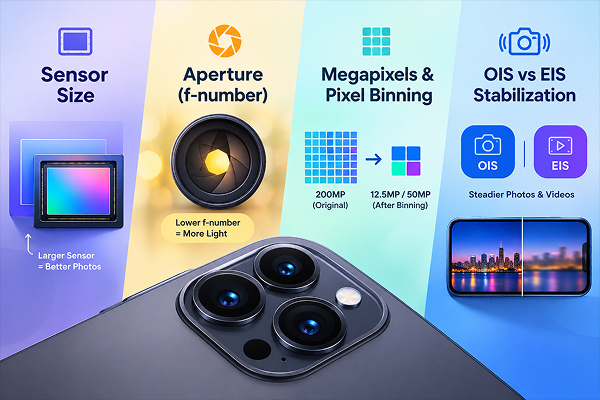
- Sensor Size: The camera sensor collects light when you take a photo. A larger camera sensor can capture more light, resulting in brighter photos, better details and less noise. That’s why a 50MP camera with a larger sensor can take better photos than a 108MP camera with a smaller sensor. So, do focus on the sensor size.
- Aperture (f-number): Aperture shows how much light can enter the camera lens. It is measured in f-numbers such as f/1.8 or f/2.4. A lower f-number means a wider aperture, more light and better low-light photos. It can also create a softer background. So, look for a camera with a lower f-number.
- Megapixels and Pixel Binning: Megapixels show how much detail a camera can capture, but higher numbers do not always mean better photos. Pixel binning combines small pixels to improve low-light performance and reduce noise. For example, a 200MP camera may combine pixels to produce a 12.5MP or 50MP photo. So, don’t judge a camera by megapixels alone, check pixel binning as well.
- OIS vs EIS Stabilization: OIS reduces hand movement using the camera hardware, while EIS uses software to make videos steadier. Both are useful for night photos and videos, especially when moving. Most advanced phones today use both OIS and EIS. Hence, look for a phone with stabilization feature if you regularly take photos at night or record videos while moving.
The Zoom Camera — What to Look For
A dedicated zoom camera is yet another crucial factor to consider. It can make a major difference, especially when you photograph distant subjects more often. A dedicated zoom camera can help capture concerts, travel, buildings, wildlife, portraits and situations where you cannot physically move closer to the subject.
Here is what to look for…
a. Optical vs Digital vs Hybrid Zoom
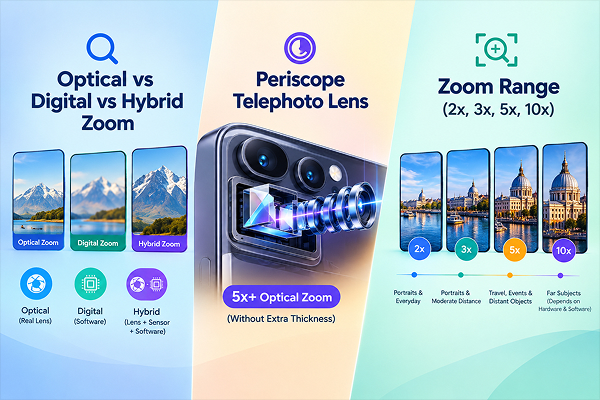
Optical zoom uses the lens to bring subjects closer while keeping more detail. Digital zoom, on the other hand, enlarges the image using software, which can reduce quality at higher levels. While, Hybrid zoom combines optical zoom with the phone’s sensor and software to improve zoom quality.
When comparing phones, check their true optical zoom rather than the maximum zoom number advertised.
b. Periscope Telephoto Lens
A periscope telephoto camera is designed to provide stronger optical zoom without making the phone extremely thick. it uses a different lens arrangement to provide stronger optical zoom without making the phone too thick. It offers useful 5x or higher optical zoom for distant subjects.
c. Zoom Range (2x, 3x, 5x, 10x)
Different zoom levels are useful for different situations. 2x is useful for portraits and everyday framing, 3x is a good for portraits and moderately distant subjects, 5x helps capture travel, events and distant objects and 10x can bring faraway subjects much closer. However, the quality depends heavily on the phone’s hardware and software.
A higher zoom capability does not automatically make the camera setup better. Understand that a very high zoom levels rely heavily on digital processing.
The Ultra-Wide Camera — When It’s Useful
An ultra-wide camera lets you fit more into the frame than the main camera. An ultra-wide camera is useful for landscapes, buildings, group photos and small spaces. However, it may not perform as well as the main camera in low light and can cause some distortion around the edges.
Therefore, it is crucial to check the resolution, aperture, sensor size and autofocus support when comparing ultra-wide cameras.
The Front Camera — What Matters for Selfies and Video Calls
The front camera becomes crucial for people who regularly take selfies, make video calls or record themselves. Of course, megapixel matter, but they are not everything. You should look for a wide aperture, good HDR support, autofocus and video recording capabilities. Autofocus helps keep your face sharp at different distances. For video calls, stabilization, microphone quality and exposure are also important.
Video Specs Explained
Video recording is yet another important factor for modern smartphone users. Here is what to look when comparing video recording features:
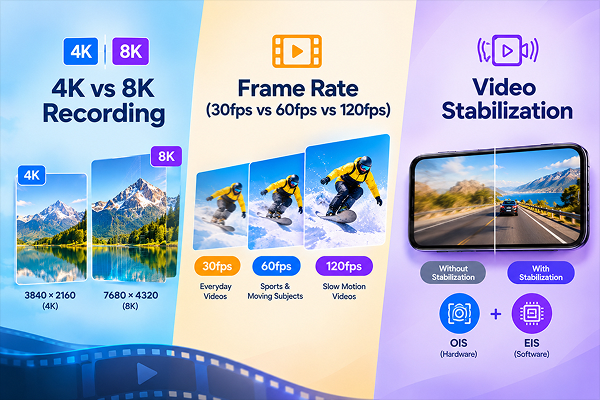
- 4K vs 8K Recording: 4K video has a resolution of 3840 × 2160 pixels, while 8K has approximately four times as many pixels. 4K video offers plenty of detail for most users and 8K video, on the other hand, provides even higher resolution but uses more storage and require more processing power. For most people, good-quality 4K video does the job well and offers a good balance of quality and storage space than 8K recording.
- Frame Rate (30fps vs 60fps vs 120fps): Frame rate tells you how many individual frames are recorded every second. 30fps is good for everyday videos, while 60fps gives smoother footage for sports and moving subjects. Higher frame rates like 120fps are mainly useful for slow-motion videos. However, they use more storage and may not perform as well in low light.
- Video Stabilization: Good stabilization can take your videos to next level. OIS helps reduce physical camera movement, while EIS can use software to smooth footage. If you often record while walking or travelling, check how smoothly the phone handles movement in real-world use, not just whether it has stabilization.
AI and Computational Photography
Modern smartphone cameras rely heavily on software. AI and image processing can improve photos by adjusting exposure, skin tones, HDR, night shots and portraits. Phones can also combine images from different cameras and frames to create better results. That is why relying on just camera specs is not enough in today’s scenario. Even phones with average hardware can take great photos if their software is well optimized.
Camera Specs That Are Pure Marketing
Specifications that sound impressive but don’t always tell you much about real-world camera quality include:
- Extremely high megapixel counts: More megapixels do not guarantee better photos.
- Huge digital zoom numbers: A 100x or 200x zoom does not mean you will get sharp images at that level.
- 8K video: Most users may get more value from better 4K video rather than having an 8K recording.
- More number of cameras: Having more cameras do not automatically make a phone better than one with lesser number of cameras.
- AI camera claims: AI features can be useful, but AI alone cannot guarantee better photos.
Therefore, you are advised to look at the complete camera system instead of just focusing on one impressive number or feature to ensure the best purchase.
How to Compare Two Phones’ Cameras Using Specs Alone
Here is a simple checklist to compare phones’ cameras; take a look…
| Camera Spec | What to Check | Why It Matters |
| Main Sensor | Larger sensor | To capture more light and detail |
| Megapixels | 50MP, 108MP, 200MP, etc. | Don’t judge on MP alone |
| Aperture | Lower f-number | Allows more light to enter the lens |
| OIS | Check if available | Helps reduce blur in photos and shaky videos |
| Telephoto Camera | 2x, 3x, 5x optical zoom (Check true optical zoom) | Provides better-quality zoom |
| Periscope Lens | 5x or higher optical zoom | Useful for distant subjects |
| Ultra-Wide Camera | Sensor size, aperture and autofocus | Important for landscapes and group photos |
| Front Camera | Resolution, autofocus and video quality | Helps with selfies and video calls |
| Video Recording | Good 4K support | Ideal in most cases |
| Frame Rate | 30fps, 60fps or 120fps | Higher frame rates provide smoother or slow-motion video |
| Camera Software | AI, HDR and night mode | For improved final photo quality |
The Bottom Line
So, there you have it: a detailed guide on smartphone camera specs. Hopefully, this article has been informative for you and you can use it to choose the best camera smartphone. The whole point is that you need to start looking beyond megapixels and maximum zoom numbers when buying a new camera phone. Sensor size, aperture, stabilization, optical zoom and video quality can tell you much more about the phone’s camera quality than just higher numbers.
Besides that, pay attention to software as well. Software plays a crucial role in modern smartphone photography. A phone with good image processing can take better photos than its specs suggest. Camera specs are important to consider, but don’t forget to check real-life photos, reviews and video tests when buying a phone. Doing so will help you have a better idea of the camera’s performance in real-world.